US war: Over fifty days of costly effort with no results
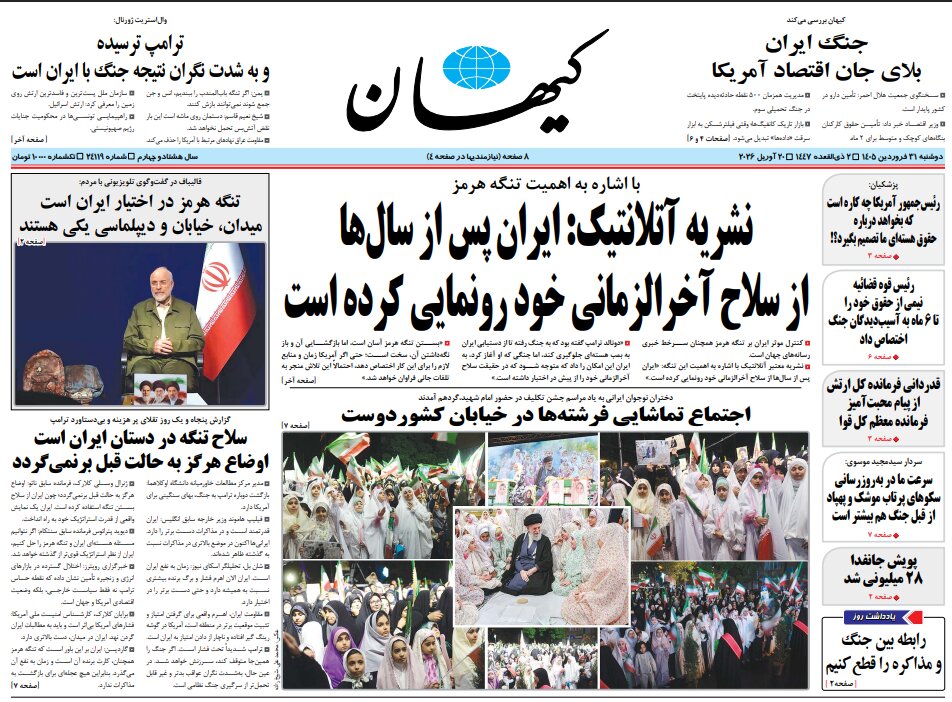
Kayhan, in an editorial, examined Trump’s costly and fruitless efforts. The paper writes that the two‑week ceasefire ends on Wednesday, yet despite bearing enormous and miscalculated costs, Trump has failed to secure any presentable achievement — neither on the battlefield nor at the negotiating table. For this reason, he is under intense pressure. If he stops the war at this point, he will face severe criticism.
At the same time, two contradictory concerns preoccupy him and his team: putting pressure to extract concessions, and the possibility that such pressure could trigger a larger counter‑strike from Iran. In the negotiations, Iran must place credible operational threats on the table in advance, directly opposite the enemy’s threats. Trump and his administration must be certain that Iran and its allies have prepared even more painful operational options — for example, adding the closure of Bab al‑Mandab to the Strait of Hormuz, or crippling the transit of oil, energy, and goods.
Etemad: Maximizing achievements in the shortest possible time
Etemad spoke with Morteza Makki, a foreign‑policy expert, about the growing US inclination toward reaching an agreement with Iran. According to this international‑relations analyst, under current conditions, time appears to be moving increasingly in Iran’s favor. In contrast, the Americans face political and temporal constraints. Among them is the fact that in the coming months, the United States will be occupied with major events such as activities related to the FIFA World Cup. On the other hand, the administration of Trump needs to present a clear, tangible achievement from this crisis. Nevertheless, the nature of the actions and positions taken by the Trump administration suggests that they are sensitive to the prolongation of the war and do not consider the continuation of this situation to be in their interest. For this reason, they are seeking to secure the maximum possible achievement in the shortest amount of time.
Sobh-e-No: National consensus as the backbone of diplomacy
Sobh‑e‑No analyzed the sources of strength behind Iran’s diplomatic apparatus. Today’s negotiating team benefits from a level of support that goes beyond any single political faction — a factor that has increased Iran’s influence and bargaining power in the face of international proposals. Domestic stability and the management of livelihoods during a crisis have effectively conveyed Iran’s message of strength to Western counterparts. The system’s key advantage in the current situation is the creation of unified messaging among the government, state institutions, and the battlefield. This coordination has made the other side realize that it is facing a single, cohesive entity — a unity that must also be preserved at the negotiating table. The ultimate goal of the system is the long‑term protection of national interests. While temporary agreements may help resolve immediate issues, they must not distract from the primary objective: the lasting removal of sanctions and the consolidation of Iran’s regional position.
Hamshahri: Gunpowder diplomacy, a fragile balance between deterrence and war
Hamshahri wrote that the current state of regional relations and conflicts can be described within a framework referred to as ‘gunpowder diplomacy.’ Broadly speaking, what is visible is that neither side has an immediate or strong desire to resume war. Tehran is reviewing the frameworks and clauses under discussion, while the opposing side is attempting to achieve its goals through propaganda and media noise. What is clear, the paper argues, is that power‑balancing within the negotiations — and the use of geopolitical tools, especially the strategic position of the Strait of Hormuz — plays a decisive role in shaping the direction of both parties. Interventionist actors, such as the Israeli regime, are trying to push the situation toward renewed conflict. Yet behind the rhetoric of the US president, there appear to be constraints that could act as deterrents, preventing a return to open warfare.
Khorasan: Iran’s conditions come first
Khorasan examined Iran’s strong position in the negotiations and wrote that, given the American side’s intentions, the Islamabad talks were never expected to conclude the first round. Although there is still no confirmed news about a new round of negotiations, one issue requires special attention. The paper argues that the Islamabad talks cannot — and should not — be treated as a continuation of the pre‑Ramadan Geneva negotiations, because that agenda was designed to prevent a war that has already occurred. With Iran’s victory in 39 days of defending its national security, new options now exist for consolidating battlefield gains at the negotiating table. This point — which was fully observed in the first round of talks in Pakistan, where the Iranian team firmly insisted that discussions proceed strictly within the framework of Tehran’s ten conditions — must remain the priority in designing any potential future negotiations.
Leave a Comment